Can I identify a suitable sprinkler replacement by its appearance?
No. Similar appearance does not establish the product, compatibility or suitability for the installed system. Give the qualified provider the concern, location and available component records. Ask it to identify the exact equipment and replacement basis. Include sprinkler review when finishes or obstructions change, and leave component handling and alteration to the responsible personnel.
A safe photograph can help describe where the concern is, but it cannot settle every product attribute. Keep the confirmed manufacturer and identification information with the resulting work record. Treat coverplates and finish questions as part of the specified component discussion.
Read the basis: Viking Group · Viking Group
- Report visible concerns without touching or altering components.
- Use provider-confirmed identification and compatible specifications.
- Reconcile each repair with its original report item and location.
Heat-sensitive element
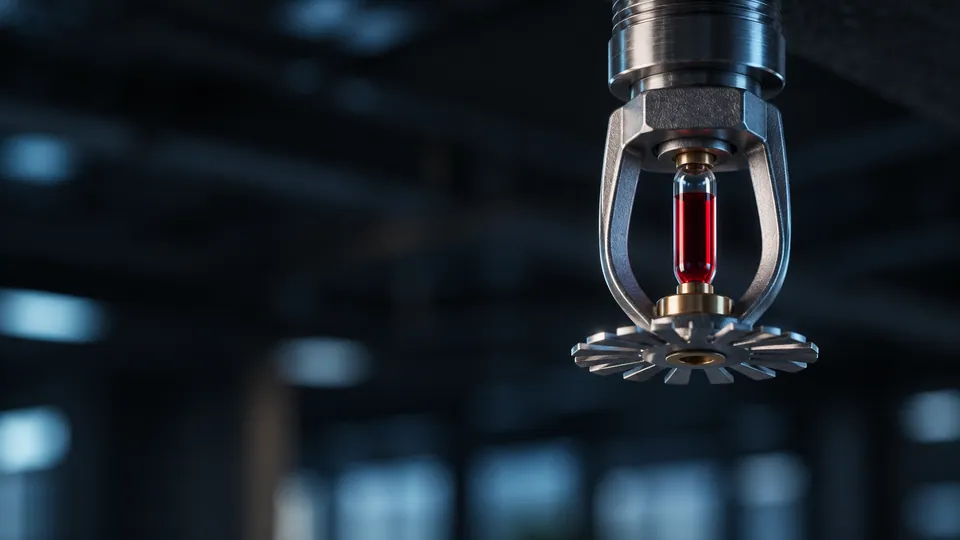
In this closed automatic sprinkler illustration, the glass bulb is part of the heat-responsive assembly. Ordinary closed sprinklers respond individually to sufficient heat; a smoke alarm is a separate device. Other sprinkler designs use different elements.
What do the exact manufacturer data and approved design say about this installed model?
Educational illustration. Establish the actual system and exact equipment with qualified professionals. No operating controls, design or performance simulation.
Understand the visible parts
The home-page illustration labels a representative automatic sprinkler’s inlet, frame, heat-responsive element and deflector. It is an illustration, not an identification chart. Installed products differ, and concealed models can present a different visible appearance.
Use drawings and manufacturer information to establish the equipment. Do not identify a component solely by a photograph, colour or internet comparison.
Report a concern without touching it
Describe visible damage, paint, missing trim, suspected corrosion or an obstruction from a safe ordinary position. Record the room and report reference if available. Do not scrape, clean, coat, bend, cover or hang objects from a sprinkler. Have a qualified provider assess the concern.
Renovation teams should know who protects the equipment during finish work and who assesses it afterward. Ordinary painting or ceiling work can create a sprinkler coordination issue.
- Heat-responsive element
- Separate alarm signal
- Neighbouring closed heads
Two different jobs
The sprinkler is a water-distribution component. The smoke detector belongs to a warning system. Sharing a room does not make them the same device.
Which devices and systems are identified in this building’s records?
Choose a step or play the sequence.
The illustration and written steps are available below. Enable JavaScript to use the step controls.
Keep warning and water response distinct. Use the building’s records to understand how its particular systems connect.
Conceptual closed-head illustration. No fire, heat spread, discharge, coverage or response-time simulation. For fire, smoke or immediate danger, get out and call 9-1-1.
Read the four steps
Two different jobs
The sprinkler is a water-distribution component. The smoke detector belongs to a warning system. Sharing a room does not make them the same device.
Ask: Which devices and systems are identified in this building’s records?
Heat at the sprinkler
A conventional closed automatic head has a heat-responsive element. The amber highlight draws attention to that element, not to a temperature setting or an activation countdown.
Ask: What exact sprinkler model and arrangement are installed?
A separate alarm signal
Smoke detection can produce a warning signal. The signal shown here does not open the conventional closed head. Specialized release arrangements need their own explanation.
Ask: Who can explain the alarm interfaces for this particular installation?
Each head responds locally
Opening one closed automatic head does not itself open neighbouring closed heads. Other heads may respond if heat reaches their own elements. This drawing does not predict how many would operate.
Ask: Can the qualified provider explain the actual system, including any specialized arrangement?
Ask how replacement is specified
- Exact equipment and documented application.
- Compatibility with the installed system and cover arrangement.
- Applicable manufacturer and design requirements.
- Who performs the replacement and manages any interruption.
- Required checks and updated records after the work.
An online retail part that looks similar is not a substitute for that assessment. Ask the provider to explain the specification in the repair scope.
Keep the component history useful
Link the replaced item to its original finding, work order and completion evidence. For repeated issues, ask what has been investigated about the cause. Preserve the model details supplied by the contractor so later service does not start from guesswork.
If a report lists several locations, use the same location labels in repair communications. Ambiguous “head replaced” notes are hard to reconcile with a multi-item report.
Make finish and obstruction changes visible
Tell the qualified team about new ceiling features, partitions, high storage or equipment near protected areas. This page does not give a universal clearance measurement: the actual design, sprinkler type and applicable requirements need assessment. Ask which specific restrictions apply to the space and how they should be communicated to occupants.
Owner scenario: a finish project creates several different findings
Consider a building repainting common areas. After the work, a service report identifies a concern at one sprinkler, a missing cover at another location and a possible obstruction near a newly installed ceiling feature. A contractor offers a single price described as “sprinkler touch-ups.” That description is too vague to show which findings it addresses or what equipment and assessment are included. The owner should ask for a scope tied to the report’s individual locations.
Keep the original item references and record the affected room or area as the provider named it. Ask the qualified team to identify each component and explain the proposed work. A cover issue, a sprinkler replacement and an assessment of a ceiling feature may require different information. Do not merge them into an aesthetic concern merely because they all became visible during the same finish project.
Give the team the finish proposal, any relevant ceiling drawings and the service report. Ask who coordinates the work with the painter or ceiling contractor and who supplies the records of completion. The owner can arrange access and document the project history; it should not select a substitute from an online picture or ask the finish contractor to restore the sprinkler’s appearance.
When the work is complete, reconcile each original item with the provider’s evidence. If the new ceiling feature remains outside the repair scope, keep that question open for the appropriate assessment. Do not treat a replaced cover as proof that all finish-related findings were resolved. This scenario explains how to manage distinct issues without giving an identification procedure, replacement method or universal clearance rule.
Use identification information without turning it into a shopping list
Manufacturer records can help the qualified provider establish an exact product. Viking’s sprinkler identification number directory is an example of a manufacturer resource, not a directory of interchangeable parts. An owner can retain the identification supplied by its provider and ask which documents support it, while leaving suitability and replacement specification to the qualified team.
| Record to request | What it helps distinguish | What it does not establish alone |
|---|---|---|
| Provider-confirmed product identification | The documented component rather than a visually similar item. | Suitability of a substitute in the actual installation. |
| Application and component relationship | The sprinkler, cover and related equipment relevant to the finding. | Compatibility based on appearance or a shared brand. |
| Original finding and location | Which reported issue the work is intended to resolve. | That other locations or ceiling changes were assessed. |
| Completion record and remaining questions | The work confirmed and the scope still outstanding. | Approval of the entire system from an isolated repair. |
Store identification details with the work order and report, including the provider’s document references. If the original product cannot be established from existing records, ask how the uncertainty will be resolved before a replacement scope is finalized. Do not use a bulb colour, a trim photograph or a retailer’s description to fill the gap.
A spare-parts record can also be useful when the qualified provider establishes what belongs with the property’s installation. Ask how its information is kept current after changes. This page does not specify spare quantities, cabinet contents or replacement instructions. The aim is a reliable equipment record, not an owner-managed parts substitution programme.
Ask clear questions about appearance, space and repairs
Owners often meet the sprinkler system through a finish concern rather than a design document. A ceiling contractor wants a cleaner look, a tenant wants a different partition, or storage now sits close to a protected area. Bring the desired change to the qualified team as a project question. Ask what must be assessed before the work proceeds, instead of assuming the visible component can be adapted to suit the finish.
- Which exact report item and location does the proposed repair address?
- How will the provider establish the specified component and any cover compatibility?
- Are nearby ceiling, partition or storage changes included in the assessment?
- Who coordinates any necessary interruption and the applicable completed-work records?
- Which restrictions should the owner communicate to finish contractors, tenants and occupants for this actual space?
Compare proposals by that scope. A quote for one identified component is different from a review of a changed ceiling layout. Ask providers to state which question they are answering and what they have assumed about the surrounding installation. A cosmetic description such as “matching cover” does not explain the specification or the record that will be supplied.
Keep observations factual and safe. Record the room and report reference, and use existing photographs only where they can be obtained from an ordinary safe position without touching equipment. Do not access concealed parts to improve a photograph. The building record tracker can help keep item-specific follow-up questions together. Active leakage or a suspected impairment belongs with the established qualified response contacts; finish work does not make that concern a routine website enquiry.
The language behind the guide.
- Coverplate
- A specified visible part used with a compatible concealed sprinkler.
- Sprinkler identification number
- A manufacturer identifier used to help identify a sprinkler model.
- Compatibility
- Whether parts are suitable together for the stated product and application.
Questions you may have
Can I paint a sprinkler to match the ceiling?
Do not paint or coat the sprinkler. Ask the qualified provider about an approved appearance solution for the actual equipment.
Can I replace a missing concealed cover with any matching disc?
No. Have the provider identify the appropriate component and compatibility.
Does a head’s bulb colour alone tell me the whole specification?
No. Identification and selection need the complete product and application information.
Does a manufacturer directory authorize a replacement?
No. A product-identification resource helps establish information about a component. Suitability in the actual installation still needs the appropriate manufacturer, design and qualified-provider assessment.
How do I confirm that several report items were resolved?
Ask the provider’s completion record to reference the original items and locations, explaining completed work and any limitations. Keep a separate follow-up for an issue that remained outside the repair scope.
References and scope
- Fire-protection product catalogue — Viking Group. Manufacturer product information. A catalogue is not approval to substitute a component. Link reviewed 2026-09-30.
- Sprinkler fitter — trade description — Red Seal Program. Trade scope; does not establish a specific company’s qualifications or provincial licensing. Link reviewed 2026-09-30.
- Sprinkler identification number directory — Viking Group. Manufacturer identification resource. A directory entry is not approval to select or substitute a sprinkler in an installed system. Link reviewed 2026-10-02.
Review dates identify source-link checks, not professional certification or a building-specific determination. Confirm current jurisdiction and exact-model requirements for actual work.
Bring the right questions.
Describe the location, property and need. The HAUSE team reviews the request; availability, scope and scheduling require separate confirmation.
Prepare an enquiry ↗